Showing posts with label Technology. Show all posts

Friday, August 4, 2017

MIND MAP: BUBBL.US


Image result for bubbl
SOURCE: bubbl.us


Mind mapping! Ahh, the advantages of retaining information by “mapping” the way the brain creates and affiliates connections. This technique brings clarity to the decision-making process by using word, image, rhythm, spatial awareness, colour and logic.
The importance of each idea is indicated by its centre point, ie: the main idea. Then begin the links between key concepts and their connection to each other. The brain works with those key concept structures to recall and retain new information with ease.
One great tool I’ve found to help ease the retention of information leading up to exams or researching for essays is Bubbl.us Its brainstorming and techniques for mind mapping allow for users online to create colourful mind maps that you can share with other users, students and friends. HELPFUL, if you’re a uni student, right?!


Image result for mind mapping
SOURCE: https://www.mindmeister.com/blog/students-guide-to-mind-mapping/


Monday, July 17, 2017

REVIEWING THE REVIEWS: CATFISH (2008 DOCUMENTARY)

Image result for catfish documentary
SOURCE: Catfish Documentary


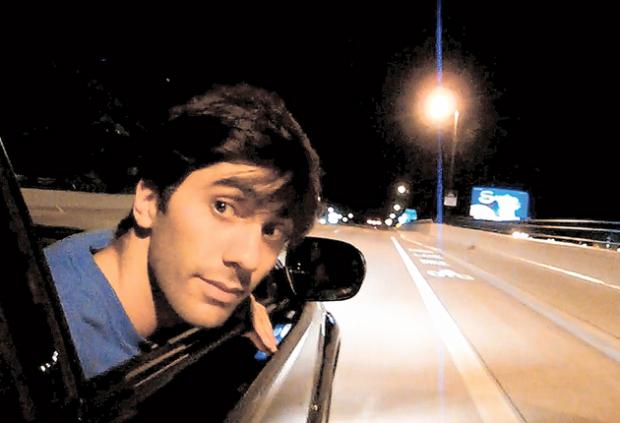
Massively criticized documentary CATFISH, is a 2008 post-modern film that, considered a hoax, follows the story of a film maker named Nev, a guy from New York who befriends a young country girl named Abby after she emails him a painting of his work. Nev engages a friendly online relationship with Abby's family; her older sister, Megan, and their mother, Angela over Facebook. As he becomes more and more romantically involved with Megan via IMs, texts, phone calls, little details start to become twisted and introduces the implications and dangers of online identities and the people behind them. 

517788.bin 
SOURCE: Nev on his way to hunt down fact from fiction. A review from The Independent suspicious of real and fake.
In viewing this “documentary” I felt an array of emotions, first dark mocking humour for the good-looking guy about to get his heart broken to the audacity of lengths people will go through to construct false or extended identities for themselves online, to then feeling sympathetic and sad for those same people.
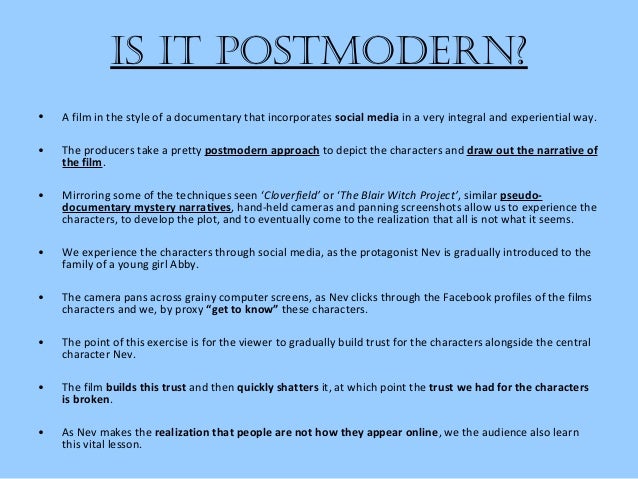
is it Postmodern?• A film in the style of a documentary that incorporates social media in a very integral and experiential...
SOURCE: A post modern review on the film relate-able with my reckonings

It’s definitely a rollercoaster of emotion with relatable and relevant representation of (real) characters in this film, at any time you are able to empathise and put yourself in the shoes of all involved; the protagonist, the antagonist and the anti-hero, with good fairness of depiction (once the boys had ‘figured’ out what was going on) to the characters, all but one: Little Abby. With having no thought for potential damage, the film may cause her while growing up, all involved didn’t stop to think exploiting this young girl could inevitably result in facing the fall out of her mothers fantasy life that was displayed in cinemas across the world, without being given the correct coping mechanisms to help her manage the ordeal she had no say in to begin with.

The Guardian Fact or Fiction is another review which presents issues supporting the falsities behind the documentary.

Image result for on the internet people dont know youre a dog
 SOURCE: An idiom turned meme which is a popularized cartoon in The New Yorker, it has come to illustrate an understanding about the way privacy and anonymity work on the Internet.

Wednesday, July 12, 2017

TED TALKS : HOW THE INTERNET ENABLES INTIMACY (ONLINE IDENTITY)

Related image


SOURCE: Ted Talks

So recently in viewing particular Ted Talks that delve into the significance of ‘online identity’ I came across one particular video that took my fancy in a really peculiar way. I quite often mock the internet, in one hand I detest anything to do with online interaction while I part-take willingly in all forms of social media with the other. My relationship with the internet/online communication is drenched in sarcasm and an unhealthy dependence, which often feeds off each other and will make for a satirical online persona. But aside from my rejection to modern technology, the ability to contact my loved ones in an instant is why I my social media accounts are still active.

I found myself relating very heavily and sympathising to the talk which Stefana Broadbent gave on ‘How the Internet Enables Intimacy’ she basically striped away the substantial layers of the internet and spoke of the fundamental, basic acts of love we can communicate to our loved ones while on the road, workplace, classroom or office. A communication that allows us to break daily isolation institutions impose by having presence on the internet and online identity. She gave such examples of a baker who must wake extremely early for work with the opportunity to sneak away from kneading dough at 8am to message his wife who is starting her day, or a mother who is able to wish family members goodnight while she starts her late shift.

Examples like these really reiterate why being apart of online society and having social presence and identity is important, I think, anyway. 

Above is an embedded video of Stefana Broadbent's Ted Talk on How the Internet Enables Intimacy

Tuesday, July 4, 2017

CONSUMER COMMUNICATION TECHNOLOGIES TIMELINE


A COMMUNICATIONS TIME LINE!!! A timeline I made that consists of  consumer communication technologies found from our Lab Task slides. My timeline is from the birth, or invention of each item, we have;


1900: Kodak Brownie Camera 
1956: The Remote Control for television
1965: Kodak Super 8mm Film
1982: Rotary Telephone
1982: CD ROM
1982: Beta Cam VCR
1985: HI-8 Video
1992: Mini Disk Player
1992: 56K Dial Up Modem
2000: The Floppy Disk

For all those eager to listen of ten hours worth of 56k internet dial up, click above ;) you're welcome

Monday, July 3, 2017

TO READ: "THE SYSTEM OF OBJECTS" BY JEAN BAUDRILLARD

Image result for jean baudrillard

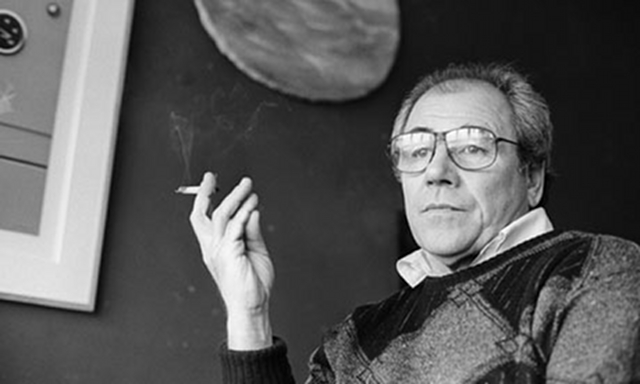
Since class last Tuesday, I have been frantically googling and oogling over the works and words of the Frenchman Jean Baudrillard. A cultural theorist, sociologist, philosopher, political commentator and photographer he is best known for his analyses of contemporary culture and media, technological communication and concepts of hyperreality. But what I’m most excited to get into are his diverse subjects on gender relations, social history, art and popular culture.

In touching on the topic of bygone objects and the romanticisation of antique technologies that leave us feeling nostalgic or moved by the presence of the past, Baudrillard’s name came into conversation and with a little bit of research a very interesting book of his called “The Consumer:Society Myths and Structures” came up.


AND IT LOOKS FANTASTIC! Especially that he wrote it in the 70’s (My favourite era to romanticize and dream (ironically) of what it was to live in a time of the glitterati, opulent establishment, the disco, the punk, to be inundated with consumerist feeding frenzies and the way media was revolutionised.
The book includes Baudrillard's most organized discussion of mass media culture, the meaning of leisure and anomie in affluent society. But alas, the book was $65(AU). And a cool sixty on a book is not something a poor student can afford as yet, so I opted for the next cheapest, ever interesting and post-modern. “The System of Objects” A cultural critique of the commodity in consumer society, which brilliantly communicates to us all the live ideas of the day.

I'll let you know what I think when it arrives! I purchased my copy on Booktopia.

Monday, June 26, 2017

ARISTOTLE: MODE OF [ONE SIDED] COMMUNICATION IS KEY

Related image

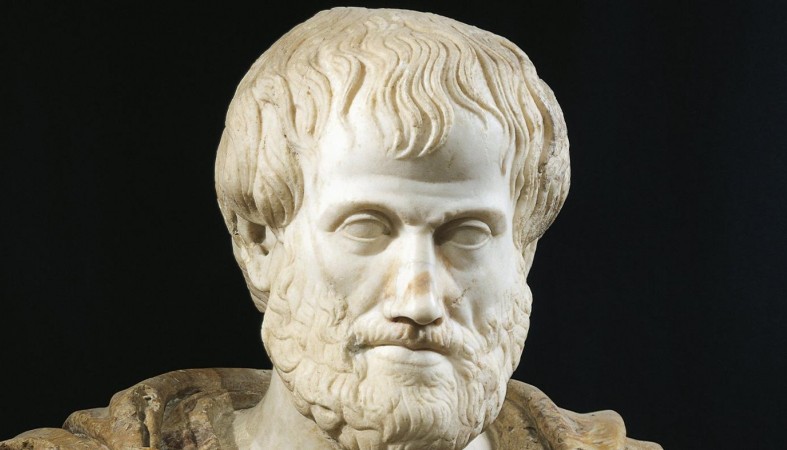
The Greek philosopher Aristotle who, I might add lived in 384-322 B.C. (So taking his great teachings with a grain of salt is much required.) Had plenty of impressive revisions under his girdle. Physics, logic, mathematics and he even tutored hotshot military-man Alexander the Great to name a few. But while in his exploration of the human nature, Aristotle developed a linear model of communication known as ~“ARISTOTLES MODE OF COMMUNICATION”~ Which was considered the first model of communication proposed before 300 B.C.

Aristotle giving Alexander the Great his reckonings

What I found interesting is even though this particular model can only be used in public speaking (As there was no concept of feedback or communication failures like noise and barriers taken into account) Aristotles Model is mainly focused on speaker and speech, and like much of his work, is vaguely divided into 5 primary elements: Speaker, Speech, Occasion, Audience and Effect.

Aristotle's Model of Communication

As you can see from this BORING diagram (I tried to find something a little more exhilarating to engage in but alas, could not) Aristotles model explains a speaker centred model as the only active speaker that has the most important role of delivering speech to the passive and influenced audience. Open to many interpretations and criticisms; one of which by Shannon and Weaver, This makes the communication process which must be clear in speech with very good non-verbal communication, only one way.

Now I’m unsure about you and I’m by no means a scholar of physics, logic, human nature or mathematics and the only person I’ve successfully tutored once was a foreign student all the swear words in the English dictionary but one way communication seems a little dictator-y and propaganda-ry to me, don’t you think? But that’s just my reckoning.


PLATO'S ALLEGORICAL CAVE RECKONING

First, there was Socrates! Old Socs in the middle probably giving his mates his reckonings, Plato by his side getting excited Athenian sty...